Lawrenceville, GA · Garage Door Service
Mountain Park homes built around 1979 often have older track hardware that lets doors jump the rail. Lawrenceville Garage Door Pros repairs off-track doors here.
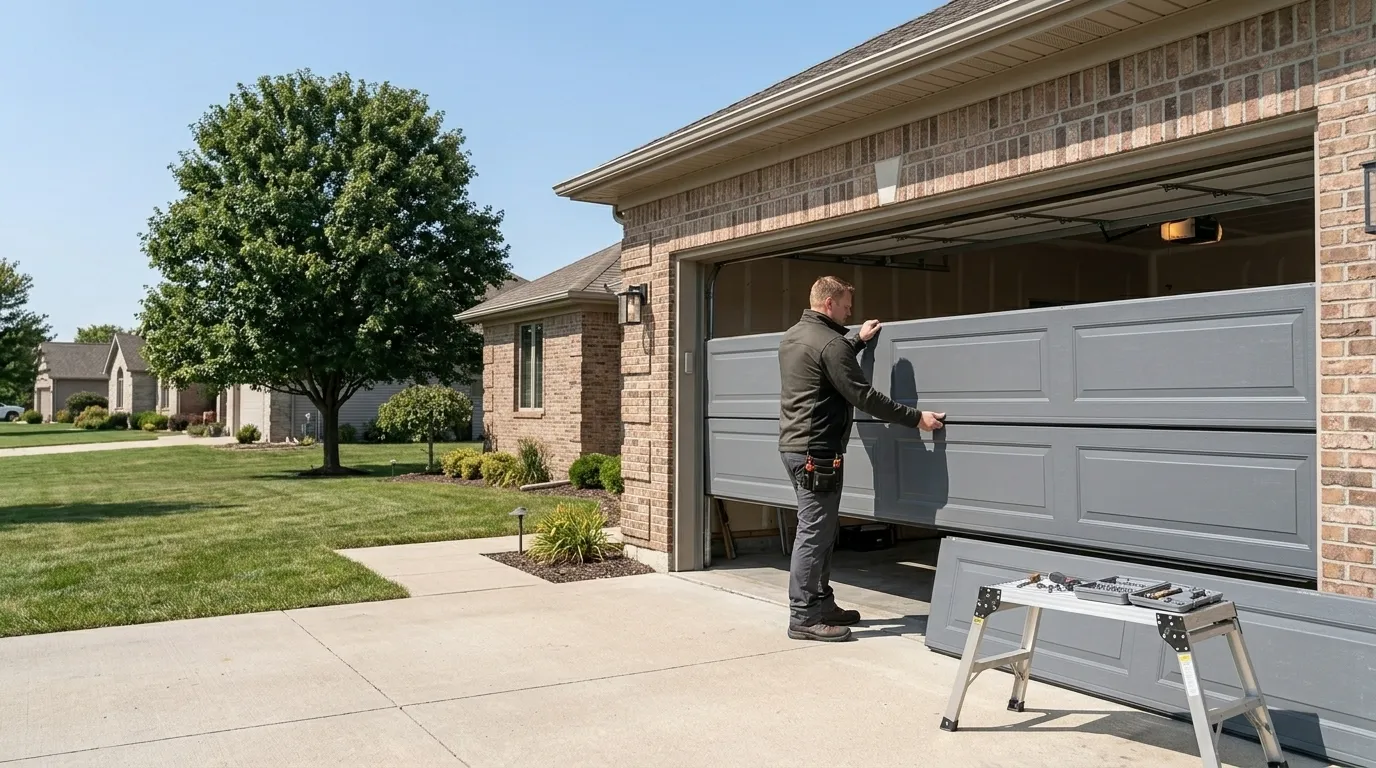
Mountain Park's houses cluster around a median build year of 1979, which puts a lot of doors here on hardware from the tail end of the extension-spring era, before torsion setups and safety cables became standard on new installs. Tracks from that period were bent lighter-gauge steel, hung on brackets that have had four decades to work loose from the jamb. When a bracket walks even a quarter inch, the roller stops tracking square and the door starts riding the edge of the rail instead of the channel. That's the start of an off-track door, and it's a different failure than you'd see in a subdivision built in the 1990s or 2000s, where the track gauge is heavier and the brackets are lag-bolted into engineered framing. Add in 40-plus years of freeze-thaw cycling under this region's cold-moderate winters (per F3), and the wood jambs those brackets are set into have shrunk and swelled enough times that the fasteners no longer bite the way they did in 1979. We see this pattern often enough in older sections of the county that it's worth naming directly rather than treating every off-track call the same way.
The door usually still moves, which is what makes this fault dangerous rather than obvious. You'll hear a scrape or a metallic pop as the door travels, and if you look at the bottom corner on the side that's failing, the roller sits visibly outside the track lip instead of inside it. On older 1979-era doors, the track sections are often shorter and bolted together with fewer splice plates, so a bent joint at one splice throws off alignment for the whole run above it. Some owners notice the door binds halfway up and the opener strains or reverses. Others don't catch it until the door drops crooked and jams a corner against the frame. Either way, the door is loaded and moving on a track it's no longer seated in, which is not a wait-and-see situation.
We carry standard-width track sections, replacement rollers, and bracket hardware sized for the door widths common in the 25 named areas we cover from Lawrenceville, which includes older builds like the ones typical in Mountain Park. What we don't stock on the truck is anything custom-width or a discontinued track profile from a manufacturer that's since changed its bracket spacing - those get ordered, and that adds a day or two before we're back out. If your door still has its original 1979-era track, there's a decent chance the roller size and bracket spacing match what's in current production; where it doesn't, we'll tell you on the spot rather than force a part that won't seat right.
An off-track repair on a door that's otherwise sound - bent bracket, a section of track knocked loose, rollers worn out of round - is usually a straightforward parts-and-labor job. It gets more expensive fast if the panel itself is dented from the door riding out of the track, or if the track has been forced enough times that the mounting holes in the jamb are stripped and need new backing. Mountain Park's median household income sits at $95,678, well above the wider service area's $79,073, and we've found that owners here more often choose to replace worn hardware across the whole track run rather than patch one bracket and wait for the next one to fail. Neither approach is wrong; it depends on how many other brackets show the same wear.
The biggest complication on a 1979-built house is finding out the track brackets were never lagged into a stud in the first place - builders of that era sometimes drove screws straight into jamb trim, which holds for years and then doesn't. When that's the case, fixing the immediate off-track fault without correcting the mounting point just buys you a repeat call in a few months. Another one: if the door has been off-track long enough to bind against the opener, the opener's travel limits may need resetting once the door is back in the channel, and on units from that era the limit adjustment is mechanical, not digital, which takes more care to get right. We'll flag both of these before we start rather than after.
We start by finding out why the door left the track, not just putting it back - that means checking every bracket along the run, not only the one at the point of failure. Bent track gets swapped in sections rather than hammered back into shape, since a track that's been bent once is weaker at that point even after it looks straight again. Worn rollers get replaced as a set on that side, and any bracket seated in soft or stripped wood gets refastened into solid framing before the door goes back up. One honest limit: if the door panel itself is bent or the track has been forced enough times that the whole system is undersized for the door's weight, patching it isn't worth the callback risk, and we'll say so and talk replacement instead of repair. For homeowners in Mountain Park, see our service page or the off-track repair overview for how this fault is handled across the wider area.
No. A door that's off-track but still moving is one of the more dangerous states a garage door can be in, because it's loaded and unpredictable. It can drop suddenly or bind and slam. Stop using the opener and the manual release until someone looks at it.
Yes. Mountain Park's median build year is 1979, and doors from that era often have lighter-gauge track and brackets fastened into jamb trim rather than studs. That affects both what fails and what we need to fix it properly, not just patch it.
We cover Mountain Park from our Lawrenceville base, about 11 miles out. We don't keep a branch or crew stationed in Mountain Park itself, so scheduling runs through the same dispatch as the rest of the service area.
We'd advise against it. The door is under spring tension even when the opener is disconnected, and forcing a panel back onto a bent track can crack the panel or snap a roller loose entirely. It's a job for hands that do it regularly.
Call now or request a free quote - same-day service on most repairs, upfront written pricing.